- experience
- engage
- enjoy
Oysters are our world in Firth of Forth marine restoration project
Publish Date: Friday August 1, 2025
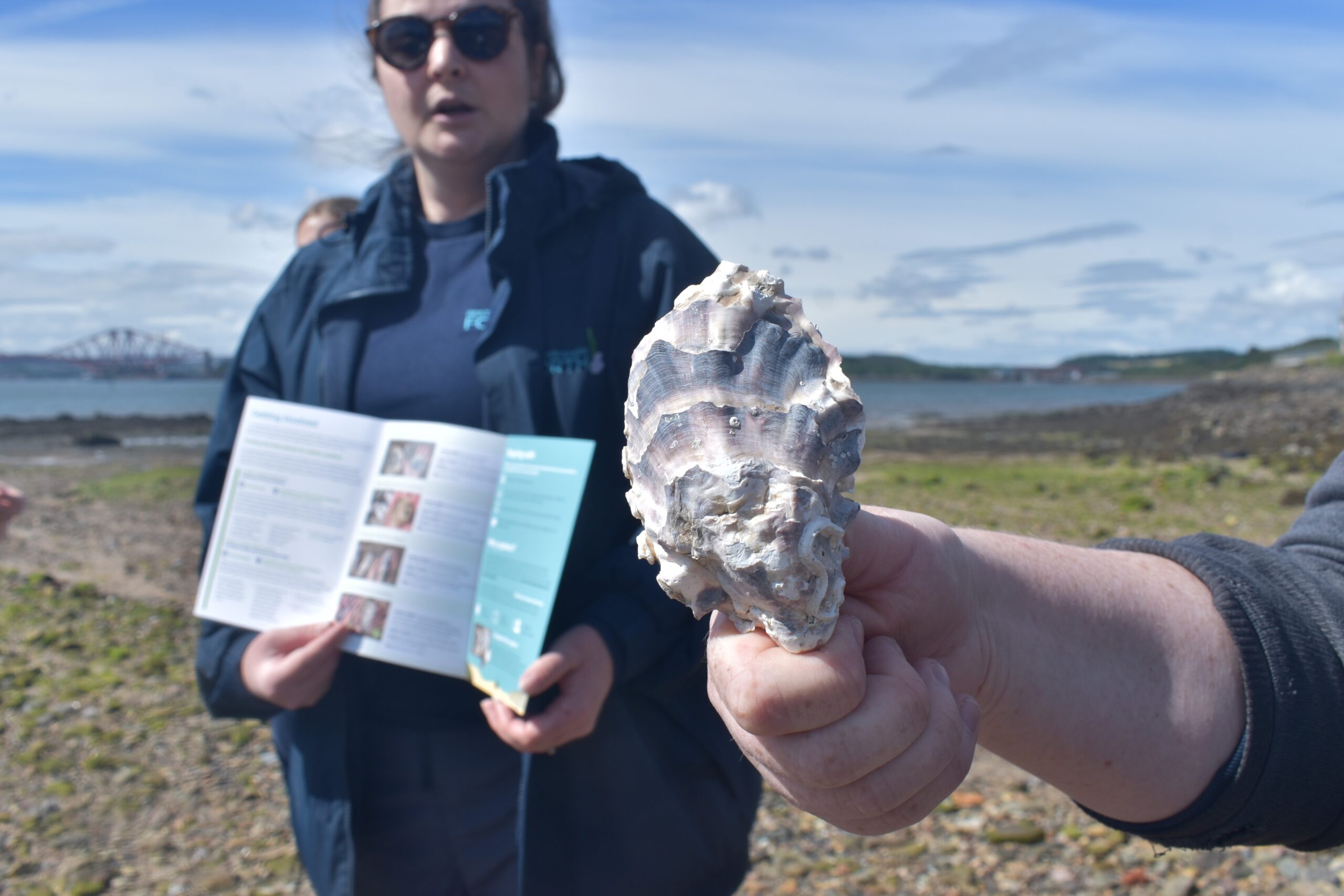
Our Communications Officer, Marjory, joined an oyster and biodiversity survey in Dalgety Bay with Restoration Forth.
Waves of saxophone music wafted over as we gathered in St David’s Harbour car park one hour before low tide. Someone was practising their instrument on the beach, which made us all smile and just added to the morning’s relaxed vibe.
A lucky 13 had signed up for the session: a mixture of curious locals, regular citizen scientists and marine biology students. We were led by Naomi and Anna from Restoration Forth, with support from their colleague Freya.
After a health and safety briefing, we moved onto the beach. St David’s beach transitions from sand to stones, shells and seaweed. At the water’s edge there’s muddy sand and small rocky outcrops, with the backdrop of three famous Forth bridges. As we formed a circle Naomi and Anna explained what we would do.
Why do we need oysters?
First, we learned how to do an oyster survey and how to complete the Restoration Forth oyster observer guide. We would collect data to indicate this area’s suitability for oyster restoration.
While oysters are now something of a delicacy, in the 18th and 19th centuries they were cheap, everyday ‘street food’. The Firth of Forth was home to a huge oyster bed and Naomi explained that, at its peak, 30 million oysters were removed each year over a 10-year period for food. By the 1900s the Forth had become over-fished and a survey in the 1940s showed there were no oysters left. It’s thought there have been no oysters growing in the Forth for a century – until this restoration project started.
Oysters are known as ‘ecosystem engineers’. They modify their environment to the benefit of other species. They create complex reef structures which provide habitats for other marine species. And oysters are proven to enhance biodiversity and even to store carbon.
Naomi and Anna showed us different types of oyster shells. Then, working in small groups, we marked out a square on the beach measuring 10 x 10 big paces. I worked with Lucy and Bob, walking backwards and forwards in our square, bent over and peering for our treasure.
Pieces of shell were 100 years old!
I was quite excited to find, and identify, some oyster shell. We gathered our finds and our leaders confirmed we had found pieces of oyster shell that would be 100 years old!
Only pieces of shells that comprise over 50% of the original shell are counted in the survey. We were shown to hold the shell, with its hinge end in the crook of our thumb and forefinger, to estimate the shell’s size. It’s not an exact science, but I reckon when you get your eye in you can make a fair enough estimation of shell size.
Bob volunteered to record our totals, using a QR code that led to the online form. It’s important to note that not finding oysters is as useful as finding them.
Biodiversity Survey
The second activity was a biodiversity survey (best done when the tide is going out). We were interested in shells, seaweed, crabs, periwinkles and the like. Working in groups we identified species using handy ID guides and then recorded them on paper.
In a scene straight out of a crime drama, a shout of ‘look!’ had me darting over the sand to one of the students. There was a dead body right enough – a tiny crab.
I took great delight in picking up the tiniest shells – needle whelks. We also recorded dog whelks, common whelks, cockles, winkles, mussels and what we decided was an otter shell.
It’s useful to collect this data before and after the oysters have been returned so that changes can be observed and information gathered about how to manage future oyster restoration.
Our survey data now goes to the scientists at Heriot-Watt University who will decide if reintroducing oysters on this part of the Firth of Forth is viable.
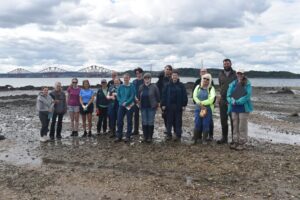
Thank you to Naomi Kennon, Heriot-Watt University, and Anna Inman, Marine Conservation Society for facilitating a fun and fascinating couple of hours.
Useful reading:
Fife Coast and Countryside Trust’s Restoration Forth project page
Get involved in Restoration Forth
Do your own oyster and biodiversity survey
Recent Blog Posts
Learning About Nature Has Made Me Way More Excited to be Outdoors
Wednesday December 17, 2025
Bringing Back the Moorland Bird Survey in Fife’s Lomond Hills
Wednesday December 3, 2025
Restoring Our Relationship with the Natural World
Tuesday February 25, 2025
