Scotland enjoys some of the best access rights in the world, meaning you have the opportunity to engage in many non-motorised activities, such as walking, swimming, cycling and horse riding, on most land and water. This provides excellent opportunities for recreation and education, and provides benefits for health and well-being. Fife Coast and Countryside Trust are managing outdoor access in Fife, delivering some of the statutory responsibilities on behalf of Fife Council.
The Outdoor Access Code
The Outdoor Access Code is a set of guidelines to help you access the outdoors responsibly, and in accordance with the Land Reform (Scotland) Act 2003. It explains that only non-motorised activities (and motorised wheelchairs) are included under access rights. The code provides guidance on responsible behaviours for users and land managers, and can be compared to the Highway Code which gives us guiding principles for driving. The Scottish Access Code is built on three main principles:
- Respect the interests of other people enjoying or working in the outdoors. This includes following reasonable advice, such as signages and diversions, from landowners.
- Care for the environment. This includes taking litter away with you, cleaning up after your dog and being aware and respectful to sensitive habitats.
- Take responsibility for your own actions. The outdoors is a working or recreational environment for many people, and you need to be aware of these to make safe and responsible decisions.
To uphold these three principles, it is essential that you understand how to react to different outdoor environments. This will help keep you and other outdoor users safe. We have put together short guidance for different outdoor environments and activities that you may experience in Fife. For each topic we have put together key messages to help you experience these environments safely and respectfully. For further information about staying safe in the countryside please click here.
Guidance for Accessing Different Outdoor Environments
How to Access the Outdoors Responsibly?
For many people, accessing the outdoors to undertake activities will require travel. However, access rights do not extend to motorised vehicles (including cars, motorbikes, campervans, and off-road vehicles), except for motorised wheelchairs for disabled users. Therefore, when needing to travel to access the outdoors it is advised that travel plans are made in advance.
- Where possible use public transport especially when visiting popular areas or areas with limited parking facilities.
- You cannot drive onto land without the landowner’s permission. Please also do not block entrances to fields, tracks or buildings.
- Please do not park on grass verges.
- Identify appropriate car parks. When using car parks please consider other users and park responsibly. For example, make sure you park within a bay, adhere to time-restrictions, and do not park for longer than the permitted time.
Farmland (crops)
A large proportion of Fife’s outdoor areas are farmland, involving the growing of crops and the rearing of animals. The agricultural industry is important both for Fife’s food production, economics and the livelihoods of local people. When walking across agricultural land we must respect the land and those who are working it. This Young Scot video gives some useful advice.
- Avoid damaging crops by keeping to field margins and walking along unsown ground.
- Long grass enclosed in felids with no livestock is often being grown for hay or silage. When the grass is above ankle hight (20 cm) you must stay on paths or go along field margins.
- When bringing dogs into agricultural areas ensure that they are under close control or on a lead.
- Access rights do not hinder ploughing or harvesting of fields. If you access farmland when this work is taking place, please proceed carefully and consider using another route.
Farmland (livestock)
A large proportion of Fife’s outdoor areas are farmland, involving the growing of crops and the rearing of animals. The agricultural industry is important both for Fife’s food production, economics and the livelihoods of local people. When walking across agricultural land we must respect the land and those who are working it.
- Stay calm and confident when walking past livestock. Where possible keep your distance and do not run.
- Never take dogs into fields where calves or lambs are present.
- Leave all gates as you find them.
Dogs
Approximately one quarter of adults own a dog in the UK. It is essential that we understand how to responsibly care for our dogs in the outdoor environment for the safety of our pets, agriculture and nature.
- In recreational areas and other public places keep your dog under close control or on a lead. Whilst your dog may be friendly, there may be other dogs or people that are nervous of your pet.
- Please pick up after your dog. Dog poo is not fertiliser and contains multiple pollutants (including unwanted nutrients and pathogens), bacteria and parasites.
- Keep dogs under close control or on a lead during bird breeding season (usually April to July) in areas such as moorlands, forests. grassland, lock shores and the seashore.
- Keep dogs under close control or on a lead when walking through fields with livestock. Never take dogs into fields where calves or lambs are present.
- If you have recently used spot-on treatment for fleas and ticks that contain Fipronil and Imidacloprid please do not let your dog into water as it contaminates waterways and is harmful to wildlife.
Close control means that the dog will respond to your commands and is kept to heel and a short lead is measured at 2m.
Additional Resources: Dog walking | Scottish Outdoor Access Code Young Scot have created a useful suite of SOAC videos.
Beaches
Fife has many scenic beaches, with our coast known as the ‘Fringe of Gold’. When accessing beaches and the foreshore please be mindful that you are sharing the beach with other people and wildlife.
- Follow local guidance aimed to reduce dune or low lying grassy plain erosion.
- Avoid disturbing nesting birds. This is very important if you have a dog and please do not allow them to approach nesting bird sites or chase birds.
- When engaging in water-based activities be mindful of other water users. Access rights only apply to non-motorised water-based activities (e.g. rowing or canoeing) under the Land Reform Act.
For more information on beaches managed by FCCT click on the link to our beaches leaflet.
Golf Courses
Fife is home to over 50 golf clubs, many of which are crossed with popular access routes such as the coastal path. There are several risks with walking on or alongside golf courses, including injury from being hit with a ball. The following guidance can help keep you, and those you are with, safe. Young Scot have created a useful golf related SOAC video.
- The word “fore” is a warning call used to alert nearby people that a golf ball is heading there way. If you hear someone shouting, cover your hands with your head, crouch and stay in this position for 10 seconds.
- You must not interfere with golf matches. This means that you (and your dog) must be still when a player about to hit a ball and always allow players to hit their ball before crossing or walking alongside fairways.
- Pay attention to signage which may inform you which way golfers are playing in retrospect to the path.
- Never walk on golf greens (these are short grass areas with the flag in them).
- Dogs must be on a short lead (2m or less) when exercising access rights.
Camping
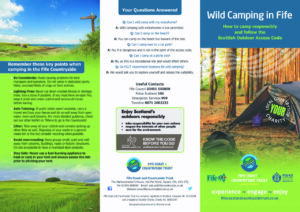
In Scotland, the right of responsible access includes lightweight camping in a tent. This must be done in small numbers and for no more than two nights. This does not include motorised camping, such as tent boxes and motorhomes.
- Use a stove rather than an open fire to reduce the risk of wildfires.
- Carry a trowel to bury your poo. It is recommended that you dig a hole 6-8 inches deep.
- Take everything you bring home with you. Once you have packed up no one should be able to tell that someone had camped there.
Additional Resources: Camping | Scottish Outdoor Access Code or download FCCT’s Before You Go Leaflet and Wild Camping Leaflet when planning to go camping.
Lighting Fires
Lighting open fires can lead to wildfires, which causes devastation to wildlife and communities.
- Leave the wood in the outdoors. Freshly cut wood (or green wood) does not burn well and has a low heat output and lots of smoke. Deadwood provides home and food for wildlife.
- Do not light a fire (including fire bowls or BBQs) during prolonged periods of dry weather, near forests, farmlands or peaty ground.
- Ensure any fire is properly extinguished before leaving a site.
- If you need to cook food, use a camping stove. This should be placed on a level, non-flammable surface away from vegetation.
Nature Reserves and Wildlife
As users of the outdoor environment, we all have a responsibility to care for the wide range of habitats and wildlife found in Fife. Whilst access rights apply to nature reserves, please be mindful that they are being managed to safeguard rare animals and plants. There are many ways that you can support conservation whilst enjoying the outdoors. Three simple ways you can do this include:
- Always take litter home and pick up after your dog.
- Using diversions that have been put in place if paths have been closed. This is particularly important for coastal habitats are endangered by erosion, which can be worsened by footfall.
- Give wildlife space and be particularly aware during breeding seasons (often between March and August).
For further guidance about outdoor environments or activities please see our suite of downloadable leaflets: Inland Leaflets – Fife Coast & Countryside Trust
Information for Landowners and Land Managers
As a landowner or land manager you must manage your land or water responsibly for access. A summary of these key responsibilities are:
- Respect access rights in managing your land or water.
- Act reasonably when asking people to avoid land operations.
- Work with Fife Coast and Countryside Trust and other organisations to help integrate access and land management.
- Consider access rights if you manage contiguous land or water (land or water the shares a common boarder).
If you have any access queries or want to work with an access officer, you can get in touch through: OutdoorAccess@fife.gov.uk
Benefits of Signage
The public do not need to keep to paths when they walk through your land. However, by having well maintained paths and good signposting you can encourage people to move through your land using a route that you have identified as safe and convenient for your work.
Landowners and land managers must show a reasonable duty of care towards people on their land. One way that you can do this is put up signs to inform people of any potential dangers. This will allow people to make responsible decisions such as putting dogs on leads or taking diversions. You must not do this in way that restricts access through creating fear and examples of good signage are in the resource section below.
Resources for landowners
Examples of signage: Signs | Scottish Outdoor Access Code
Sources to path related funding: Funding | Scottish Outdoor Access Code
Managing access on golf courses: Managing access on golf courses | Scottish Outdoor Access Code
Path Closures and Reporting Access Issues
Information about path closures can be found on Fife Council website Fife Council website.
Getting in contact
Please get in touch through: ask.us@fifecountryside.co.uk